|
|
Welcome
to Ecology Begins at Home!
Positive, practical, hopeful ways to make our world more resilient and sustainable one step at a time. Educational inspiration for building a healthier future for ourselves and the planet. Reflect, experiment, discuss and discover the joys of being a constructive force in the world! Downloads |
|
|
|
A
healthy, sustainable future lies in our hands! Nature, the entire
planetary biosphere, is our life support system and
its health lies in our hands. We live in it and
are supported by it, just like the astronauts on a
space station, supported by their energy, food, water
and air supply systems. The astronauts cannot trash
their space station, nor fill it with more people than
it can support, if they want to stay healthy and well.
Likewise if we want to remain healthy and well, we
must insure that nature stays clean, productive and
healthy, and keep our numbers and our consumption
within the limits that nature can support on an annual
basis. With a footprint of 1.7 planets, humanity is
far above that right now. Thus, it is time to roll up
our sleeves, think creatively, and start changing
things for the better, beginning at home. 1. Humanity's "trash" (the waste products of all our production and consumption), is trashing the planet with toxic and non-biodegradable materials. We are slowly poisoning ourselves and all of nature. Carbon dioxide, one of many waste products, causes global heating and an acid ocean. We need to reduce ALL our trash by consuming less, reusing and lots more sharing, i. e., by voluntarily limiting ourselves. The astronauts wouldn't live long if they ate up all their food and used up all their energy in a great on-going party, so they discipline themselves! We too can live meaningful and happy lives made safer and healthier by living moderately. Good for us, good for other species, good for the planet. 2. Every square inch of
the earth’s surface has been taken for human use
today, crowding out animals, plants, forests,
etc. Many species have died out due to lack of space
(habitat), for example, birds and
insects, making ecosystems less resilient and
less productive (see WWF Living Planet Report). All
the planet’s land, water, groundwater, minerals and
even the oceans have been conquered for human use. We
have no buffers, no surplus cushion to use in
times of drought, flooding, earthquake, fire, epidemic
or other stress. To guarantee survival of most species
and our own health, we can set aside half of our
planet's land and water as nature reserves (see E.
O. Wilson's book Half Earth and WWF's New Deal for Nature).
Since space on the planet is limited, this implies voluntarily
reducing our human populations to what each land
area can generously and healthily support and still
leave half for other species and for ecosystem
resilience. 3. Resources (forests,
fish, farmland, soil, minerals, wildlife,etc) are
shrinking because we take more from nature than
grows back each year. Lots more: the
total human ecological footprint is 1,7
planets but we in the wealthy countries have
footprints of 5-10 planets or more. Expanding cities and roads
pave over valuable farmland. Deforested
and plowed soil blows away with the wind.
Irrigation overuses groundwater and accumulates salt
in the soil. Climate change makes things worse
through heat, drought and flooding. Storms destroy
property, crops, animals and villages. Violent
conflict over dwindling resources destroy
even more resources. 4. These natural physical
limitations (or planetary
boundaries, as they are also called) put a
limit on how much humanity can grow. We have
already passed the limits, creating crowded, unhealthy
living conditions and an unstable climate. The
instability grows when we try to solve poverty with
more growth. Instead, we need to consume less and
solve poverty by sharing more. We need to improve our
health and natural economy by setting decreased
population as a primary goal in all countries
(see the free online books Overdevelopment,
Overpopulation, Overshoot and Human Overpopulation Atlas). 5. As we reduce
our demands on the common planetary resources,
we improve our situation, move
towards living within the limits, become less
vulnerable, more resilient and healthy. Virtually
everything that humans produce ends up as trash
that nature cannot reuse to regenerate new
resources. Thus, health
and sustainability are achievable goals but require
profound changes in our lifestyles and in our
production and distribution systems. Technical
change and industrial efficiency alone cannot solve the problems. As far as
"trash" goes, technology is the problem. For
example, renewable energy from solar panels has a
large resource footprint and creates a lot of trash.
The same for electric vehicles. See fact
sheet Growth vs
Health and Sustainability. The rich in all
countries (this includes you and me) must take the
lead in reducing our consumption and restoring
ecosystem health—we are the leaders of
our own revolution. See Change begins at
home. 6. Reducing our needs
and still living joyfully isn’t especially
difficult (see A secure, healthy future)
but requires a new way of thinking, thinking more of
our children's future and less of ourselves. Human
experience and research tell us that we can be happy
and fulfilled without high consumption. Our
parents were happy, weren't they, and we as
children, with only half the consumption? In
fact, above basic needs for food, clothing, shelter,
etc, science and literature
both tell us it is family, friends, health and
education that are most important. Less
consumption means less work and gives more time to
spend on valued activities. Hunter- gathering peoples worked
only about 15 hours a week, enjoying each other and
their environment the rest of the time! A key is a
more egalitarian society, where we cooperate and enjoy
rather than compete. 7. The United Nations
expresses our creative challenge for the 21st century
in the
Sustainable Development Goals (SDGs), 17 major
goals with 168 sub-goals. Underlying all these
goals are strong, resilient communities and a
healthy, stable nature (see System
Sustainability Diagram). When we know
we have healthy local agriculture, energy and
freshwater ecosystems that can provide our
basic needs indefinitely into the future, we can
truly feel hope and be satisfied. We can then help
others to achieve the same. Thus, our own community's
future, as well as the whole world's, truly lies in
our hands. It is a matter of getting our priorities
right and making change happen now. Download educational materials here:
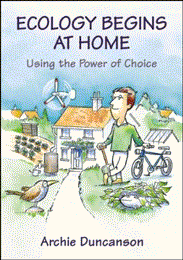
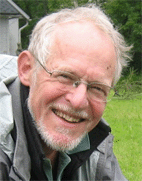
Reviews of Ecology Begins at Home —The most important single book any citizen of the planet can read on environmental issues… amazingly clear and simple… immensely empowering… bursting with creativity and the fun of exploring. Pierre Pradervand, author of The Gentle Art of Blessing, in Cygnus Books reviews, April 2009. —An essential guide to low-impact living… easy steps we can all take at home to reduce our impact on the planet. Friends of the Earth, Scotland, 2006. —Read it in one sitting and fell in love with it… fun, immediately rewarding, and easy enough to do right this minute, Community Regeneration, Rodale Institute, USA. —Easy to read… practical little book. Archie use[s] the choices he makes to change the world. The Environment Centre, Swansea, Wales, 2009. —An invaluable guide to reducing one’s impact… riveting… [for] even the most hardened environmentalist, Environment Magazine, UK, 2006. —The best book yet on how to green your lifestyle… makes the whole subject very clear and understandable. Permaculture Magazine UK, 2005. —Inspirational… within minutes I was implementing changes… If you are finding it hard to persuade family members, this book’s non-preachy methods might just work! Green Parent Magazine, UK. —The most genially simple and concrete guide to practical ecology out today. Should be spread in massive editions, not the least to children, who easily understand it and who are usually less habit-bound than we adults. Swedish Library Service 1990. Archie Duncanson, environmentalist, retired engineer and writer, lives in Stockholm, Sweden. Trained in engineering, economics, computers, optimization, statistics and systems theory at Berkeley, Stanford and UCLA. After a career as management consultant in industry, taught and wrote on how to solve the big environmental problems from the bottom up by taking personal responsibility. Believes teachers can be the most important people in life—as mentors, encouragers and by asking the questions that make you think! Copyright 2005-2020 Archie Duncanson. Contact: Pokalvägen 6-5tr, 11740 Stockolm. duncansonian=at=yahoo.com. Såettfrö Publishers, Stockholm. |
|