|
|
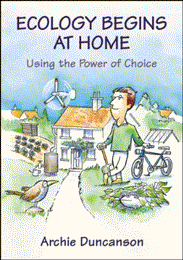
The best book yet on how to green your lifestyle …makes the whole subject very clear and understandable. Permaculture Magazine UK “Essential” Friends of the Earth “Empowering” Cygnus Books “Invaluable” Environment UK “Inspirational” Green Parent (UK) Read it in one sitting and fell in love with it … fun, immediately rewarding, and easy enough to do right this minute, Community Regeneration, Rodale Institute (USA).
|
|
|
|
Further Following are excellent in-depth background books on sustainability, climate change, economic growth and related social justice issues. Many are classics. I add books here from time to time. CONTENTS
(click to come to books reviewed below) Prosperity without
Growth, Tim Jackson, 2016. Debt, David Graeber, 2012. When the Tide Turns (system sustainability book in Swedish with a review in English), Bengt Bodin, 2014. What Then Must We Do?, Gar
Alperovitz, 2013. Owning
Our Future: The Emerging Ownership Revolution,
Marjorie Kelly, 2012. Our Common Wealth, Jonathan Rowe, 2013. Plan B 4.0: Mobilizing to Save
Civilization, Lester R. Brown, 2009-2010. The Impact of Inequality, Richard G. Wilkinson, 2005. Cannibals and Kings,
Marvin Harris, 1977. Fates of Nations, Paul
Colinvaux, 1978. Collapse,
Jared Diamond, 2005. Whose Crisis, Whose Future? Susan George, 2010. Climate Wars: The Fight for Survival as the World Overheats, Gwynne Dyer, 2010. Storms of My
Grandchildren, James Hansen, 2009. The Politics of Climate Change, Anthony Giddens, 2009. The Rough Guide to Climate Change, Robert Henson, 2011. The Economics of Climate Change: The Stern Review, Nicholas Stern, 2007. Something New Under the Sun: An environmental history of the 20th century, John McNeil, 2000. Water: A natural history, Alice Outwater, 1996. Limits to Growth: The 30 year update, Dennis Meadows, et al, 2004. Heat, George Monbiot, 2006. The Man Who Planted Trees,
Jean Giono. So Shall We Reap, Colin
Tudge, 2003. Diet for a Small Planet,
The One Straw Revolution,
Masanobu Fukuoka, 1985. The Bottom Billion, Paul
Collier, 2007. The Mystery of Capital,
Hernando Small Is Beautiful, E.
F. Schumacher, 1975. The Life of Mahatma Gandhi, Louis
Fischer, 1951. Development as Freedom,
Amartya Sen, 2001. Gaia, 2000 and The
Ages of Gaia, 1988, James Lovelock. Silenced Rivers, Patrick
Mc Cully 1996. Dictionary of
Environmental Science, Andrew Porteous, 2008.
The
Way of Lao Tzu (Tao-te ching), Wing-Tsit Chan,
1963. Lao Tzu's essay is remarkable in philosophical
depth and practical applicability to daily life. In
placing nature above all, not only as our single source
but also as our greatest teacher, it provides a
philosophy for human well-being and long term survival
that is sorely needed today. Lao Tzu's insights can help
us get back to our roots, in tune with nature and to
find peace in our daily existence in this constantly
changing world. Full Review by Archie. Dirt: The Erosion of Civilizations,
David Montgomery, 2012. Agriculture erodes the earth
because of plowing. This has led to thousand year cycles
of population growth followed by the decline of their
civilization, after people have starved and fled the
area in search of more fertile land. When the earth lies
fallow, new soil builds from the rock beneath it, but
this takes 500-1000 years. Farmers have known this since
ancient times, but in many places ignored its lessons,
resulting in declining civilizations. Overdevelopment, Overpopulation,
Overshoot, Tom Butler (ed.), 2015. Review by Archie. Reviews by others. Strong,
sometimes overpowering, photos of human society and its
enormous takeover of the Earth. A clear call for
decreasing population and decreasing consumption. The
entire book is viewable online. Ten Billion, Stephen Emmott, 2013.
Population growth drives a catastrophic extraction of
resources. Though climate change is a crisis, the
population threat is even worse, Guardian
2015-12-04. The End of Plenty: The Race to Feed a
Crowded World, Joel Bourne, 2015. Review 1. Review 2. National Geographic article. Radio interview 1. Radio interview 2. Farmer
journalist Bourne travels the world looking at the
problems and (few) solutions for feeding more people.
Cannibals and Kings,
Marvin Harris, 1977. An anthropologist’s masterful
account of man’s social evolution from stone age
hunter-gathering clans to modern day capitalistic
societies, interpreted in ecological terms.
Describes how population pressure versus food supply
has always been a problem for humans (just as for
other animals) and how it has formed various aspects
of our culture from war and infanticide to meat
taboos to the formation of despotic empires.
Population growth has forced the development of new
intensified technologies to feed the population, but
all forms of intensified food production deplete the
natural resource base, so in the long run, living
standards are reduced. Oil and coal have given some
of humanity a higher standard, but this is only
temporary as long as the oil lasts. Two conclusions
from reading this book are: First, to secure our
survival, renewable
food must
become society’s primary objective today, even more
important than renewable energy. Second, population and
consumption must both decrease radically to prevent
further destruction of resources. A fascinating
book! Cannibals and
Kings-full review.
What
Then Must We Do?, Gar Alperovitz, 2013. Professor and economic historian
Alperovitz makes a strong case for locally owned
institutions which support community development,
strengthen democracy and encourage longterm management
of common resources.
Full
review. Community-Wealth.org.
Owning Our Future, Marjorie Kelly, 2012. Describes different forms for local ownership (cooperatives, etc) with many good examples from around the world and analysis of which forms are most useful for different purposes and situations. Author's website with links to several reviews. Follows in the same spirit as What Then Must We Do by Gar Alperovitz, research by Nobel Prize winner Elinor Ostrom and Our Common Wealth: The Hidden Economy That Makes Everything Else Work by Jonathan Rowe. Our
Common Wealth: The Hidden Economy That Makes
Everything Else Work, Jonathan Rowe,
2013. Much of what we value we own in common, for
example, the air, water, biodiversity and quiet.
With almost poetic simplicity, Rowe shows us how we
can protect some of these common resources, and of
the need to protect them all. When the Tide Turns,
Bengt Bodin, 2014. This book in Swedish with the title
"När vinden vänder" explains (more clearly
than I have seen in any book in English) just how
limited are the planet's plant-growing resources in
relation to the existing population, and the
impossibility of replacing gasoline, diesel and jet
fuels with biofuels: there simply is not enough land
to grow them. Research agronomist Bengt Bodin makes
the further point that our industrialized society is
not only limited by energy but by nature's ability to
absorb our waste products, which instead of breaking
down to become part of new plant life, accumulate and
harm our health as well as the health of the planet's
ecosystems. Full review
and summary in English.
Climate Wars: The fight for
survival as the world overheats, Gwynne
Dyer, 2010. An excellent overview of the climate
change situation (updated through Copenhagen 2009),
along with the author’s interviews with leading
politicians, military advisors and government
planners, who are preparing
for the resource conflicts that are now being
aggravated by climate change. Includes scenarios that
help us visualize how future politics in the world
might play out. Climate
Wars-full review. Storms of My
Grandchildren, James
Hansen, 2009. One of the most authoritative
descriptions and analyses of climate change and its
implications by one of the world’s leading climate
scientists. Besides climate change science, Hansen
describes his problems with what can only be called
censurship in an effort to downplay the seriousness of
climate change by various American political
administrations during the 1980’s, 1990’s and 2000. Storms of My
Grandchildren: full review. Plan
B 4.0: Mobilizing to Save
Civilization, Lester
R. Brown, 2009-10. (See also his more recent book Full
Planet, Empty Plates 2012 and its accompanying
film and presentation) This excellent book concisely
describes and analyses the world’s major problems
(energy, water, air, food production, soil loss,
deforestation, desertification, overfishing, climate
change, etc.) and then outlines solutions, area by
area, for solving them using existing technology.
After convincing us of the seriousness of these
problems and that business-as-usual, free market
economics will not implement the solutions quickly
enough, Brown proposes a global-wide mass mobilization
of capital and human energy of the kind that usually
only occurs during wartime or after catastrophic
events. The key tools needed for this are regulation
(for example, bans on cutting down forest), removal
of tax subsidies (to oil, to water, to
agrobusiness, to airlines, to fishing, etc.), removal
of trade barriers (that work like subsidies to
keep the price of resources artificially low) and taxes
on critical resources (carbon dioxide,
gasoline/petrol, etc.). Such policy tools require
political decisions at all levels to implement, so our
important part is to support and vote for the
necessary policies, even though many cheap
things such as transportation and food are going to
become more expensive. What is the alternative?
“Business as usual” leads to continuing destruction of
our resource base, hunger, disease and political
instability, eventually to what many call collapse.
Better to pull in our belts now while we still have
our strength, economic institutions and political
organization. And that is what Lester Brown argues so
well for and why he gives us hope. Hope, that is, if
we use our power of choice to vote for the needed
regulations and tax increases now. The
Politics of Climate Change,
Anthony Giddens, 2009. This book offers to the climate
change solution discussion the considerable informed
experience of a renowned social scientist, political
adviser and modern thinker. The short summary of this
book is that national carbon taxes are the way to
go, not carbon trading based on big
international agreements like The
Rough Guide to Climate Change, Robert
Henson, 2011-14. A very thorough guided tour of
this enormous and complex scientific field, well
organized and well told. Presents in lay language the
major climate theories and their background as well as
hundreds of minor issues along with related and
unanswered questions. By providing historical
background on the scientific research and thinking
concerning these issues, Henson helps us understand
the complexity and why it took so long for science to
come to general agreement that the climate is warming
and that mankind is behind most of the change. Good
graphs depict earth’s climate history. Excellent
diagrams show how climate mechanisms work. Photographs
and maps make climate change concrete and real. Having
read this book, I am determined more than ever to
reduce my impact; I am also a little more humble, both
as a human being and as an “earthling”, for the planet
is very big and I am very small. The
Economics of Climate Change—The Stern Review,
Nicholas Stern, 2007. When a world class economist
says we need to get moving on climate solutions, you
listen. This monumental, extremely well organized,
thorough and detailed work describes (based on IPCC
reports) what will happen as the climate warms in
terms of food, health, poverty, water, land,
environment, migration, conflict, etc, and analyzes
governmental measures to lessen climate change (carbon
trading, taxation, etc). Highly technical in parts,
but full of summaries, research results and a wealth
of relevant information gathered into one place.
Available free
online, including a 27 page Executive Summary. Something
New
Under the Sun: An environmental history of the 20th
century, John
McNeil, Water:
A natural history, Alice
Outwater, 1996. If I were going to recommend only one
background book on the environment, this would be it.
It is a beautifully told history of the environmental
degradation of Limits
to Growth—The
30 year update, Dennis
Meadows, Jorgen Randers and Donella Meadows, 2004.
Three system scientists at MIT build a complex
computer model of humanity's total resource usage and
project the world economy into the future to see what
may happen under differing assumptions. They gather
data, study the interactions, follow new research and
refine the model for over 30 years. The key
conclusion: humanity has already surpassed the
sustainable physical limits of this planet and is
still able to expand only by consuming the planet’s
capital of farmland, forest, fish, minerals and fresh
water, etc. In the future, humanity will have to spend
an ever-increasing share of its money to obtain
energy, metals, chemicals, water, etc and on
environmental cleanup and health. This will leave less
and less money available for investment in new
technology and production facilities and, eventually,
for food production. Long time lags and many
interdependencies mean that we do not see that we have
overshot the planet’s limits. Instead we use up
important resources to the point of scarcity,
extinction and in some cases permanent destruction
(such as soil erosion, salt-drenched land, permanently
polluted groundwater and lost species), then go into
dramatic population decline caused by disease, lack of
food, poor health care and a polluted environment.
These studies are broad, thorough and sobering in
their conclusions. You can download a roughly ten-page
summary of their work at http://www.mnforsustain.org/meadows_limits_to_growth_30_year_update_2004.htm.
Collapse, Jared
Diamond, 2005. The compelling story of how a number of
earlier human societies collapsed due in part to
climate change and environmental degradation, with
parallels drawn to current places on the globe where
people’s livelihoods are threatened today by exhausted
resources, overpopulation, climate and/or
environmental damage. Multidisciplinary researcher
Diamond investigates The
Collapse of Complex Societies, Joseph Tainter,
1990. Examining many historical examples of collapsed
societies, Tainter presents the (new) theory that
collapse depended on the decreasing value of
increasing complexity, to a point where the complexity
becomes an overhead burden whose expense cannot be
supported by the outlying provinces that provide basic
food and resources to the central society. Rethinking
Environmental History, Alf Hornborg, J.R.
McNeill, Joan Martinez-Alier (editors), 2007.
Anthology with a examples of society-driven
environmental change. Presents different theories to
explain how and why the society was driven to develop
in the way it did, with the environmental effects that
then occurred. One general theme is of the central
state such as Rome commandeering resources from
peripheral colonies, a theme that has persisted to our
day in the unsymmetrical (and unfair)
developed-developing nations relationships. Heat, George
Monbiot, 2006. This book argues for a 90 percent
reduction in carbon emissions by the year 2030 (for
the UK specifically, but also for other countries),
significantly more ambitious than the current UK,
European Union or Kyoto goals—a reduction the author
believes necessary to avoid human catastrophe on the
planet. Monbiot first convinces us (if we need
convincing!) that global warming is in fact a fact,
that it is largely man-made, that rising sea levels
will destroy farmland and groundwater and flood
cities, and that these problems are already here. To
stop global warming, we must act now and forcefully to
reduce energy usage and emissions. A key method is
world-wide rationing of energy and carbon emissions
based on equal shares for all humans on the planet,
with national governments implementing the rations,
for example, by individual and industry rations that
are applied to and accounted for on the individual’s
home energy and electricity bills. Monbiot then
critically and practically analyzes the possibilities
for carbon reductions for major categories of energy
production and use (such as home heating, appliances,
automobiles, air travel, etc.), and suggests the most
likely and least painful ways of achieving a 90
percent reduction. For air travel, he can find none
except less travel. By laying many previously proposed
solutions to rest, often with simple calculations,
Monbiot forces us to see that we cannot hope to
continue to lead our lives as we have up till now. The
major projects that will need to be legislated and
implemented are, among other things: rationing (to
reduce consumption compared to today), energy
efficiency and carbon sequestration—they will not come
by themselves or through voluntary action. Monbiot
thus puts the responsibility on us to elect
politicians who will give us this bitter medicine that
we need but have been hoping to avoid. The sooner, the
better, he concludes, for our newborn children are
depending upon us. The
Man Who Planted Trees, Jean
Giono (circa 1955). Inspirational modern fable of how
one person’s faithful action, a little every day, made
a truly big difference in the world. Great for
children as well as adults! So Shall
We Reap, Colin
Tudge, 2003. This is an extensive, systematic and
detailed analysis of human food production methods and
their consequences by an experienced and very
concerned British agricultural journalist and
biologist. Thought provoking and full of detailed
background information, it provides an encouraging,
practical vision for future farming and eating habits,
based on solid scientific and agronomical experience
as well as on common sense. Tudge describes
agriculture’s history as going from local
craftsmanship rooted in practical experience and the
biology of the earth to large-scale corporate
business, rooted in money. He explains the efficiency
and robustness of mixed animal and crop farms (as in
the family farm) and of traditional diets that are
high in grains, fruits and vegetables, and low in
meat. He proposes such diets and farming practice as
our way to guarantee human well being long into the
future. Highly critical (with a well-founded case) of
agrobusiness. Diet
for a
Small The
One
Straw Revolution,
Masanobu Fukuoka, 1985. Biochemist The
Bottom
Billion, Paul
Collier, 2007. The Mystery
of Capital, Hernando Small
Is
Beautiful, E. F.
Schumacher, 1975. Economist and fellow human
Schumacher reflects deeply on the seemingly efficient
globalized economy and compares it to the efficiency
of small-scale, local activity to meet our needs and
satisfy our hearts, given that we have other values
than just money and cheap goods. Schumacher inspires
us to reflect on how we live and what we are doing
with our lives. The Life of Mahatma Gandhi, Louis
Fischer, 1951, or Non-Violent Resistance, M.
Gandhi, and/or other books by and about M.
K. Gandhi, describing his life of service
improving the lot of his fellow man. A man of awesome
integrity, he taught by example, practicing what he
preached. Key values he taught were the search for
truth, freedom, and peaceful resolution of conflict
through respect for the other person’s needs. The
Impact
of Inequality,
Richard G. Wilkinson, 2005. (See also Wilkinson's more
recent book The
Spirit Level: Why equality is better for everyone,
2010, together with Kate Pickering, with the same
basic message.) Social epidemiologist Wilkinson asks,
“Why do societies with large inequalities have worse
health and shorter lives?” Bringing together research
from around the world, Wilkinson first convinces us
that the more equal societies really do have better
health. For example, the people living in the state of
Kerala, India, known for their egalitarian state, have
a life expectancy only slightly less than Americans,
despite an average annual income per capita of no more
than about $1000. We learn that it is relative income,
not absolute, that affects health and our physical
biology, through the mechanism of stress caused by low
status and low self-esteem. Wilkinson develops his
health thesis carefully and slowly, and along the way
we find out that equality generates not only better
health in a society, but also less violence, more
trust, more involvement and generally a more cohesive
community. He is really interested in the larger
question, why is modern society such a material
success and yet a social failure? Everywhere he looks,
he finds the key to be inequality, and the underlying
cause to be man’s social nature and need for belonging
and respect. In his last chapter, Wilkinson touches on
the implications of these results for worldwide peace,
prosperity and being able to come to agreement on
environmental issues. Full of statistics and written
for public health professionals, it is fully
understandable to laymen. Development
as
Freedom,
Amartya Sen, 2001, Nobel Prize winner in Economics
1998. This treatise on development economics seeks to
use theory to find answers to very practical human
economic problems. Sen’s main message: development is
not simply a question of a raised national average
income, it is a question of raising human welfare on a
variety of fronts (health, education, work
opportunities, etc) and of raising these for all
members of society, not just raising the national
average (which may hide wide disparities between the
rich and the poor, men and women, different
geographical regions, different ethnic groups, etc).
Bringing together the research of many others as well
as his own, Sen analyzes a whole spectrum of issues
from statistical measures of welfare, to equality and
fairness constraints that do not exist in law but are
imposed by tradition and culture. Key points are that
population growth stops when women have the freedom to
decide to work or have children, that famine is not
the result of crop failure but of lack of sharing and
never occurs in a democracy, and that the South East
Asian economic boom was based on the earlier provision
of public education and healthcare for everyone. The
theme underlying this work is that we all want freedom
to pursue our life dreams. Some of this
freedom/capability can be created by raised income,
other is created by laws such as the right to vote or
own property, and still other by health and
educational programs, labor laws, and so on. Sen
discusses where the economic marketplace is a useful
mechanism and where it fails to solve the problem,
thus advising politicians to think in broader terms
than simple economic growth. This book is very
philosophical and not easily read (it was written for
economists) but its message of directing developmental
programs toward greater practical freedom and
opportunity for those who lack—and not just greater
GNP—is clear and simple and can be understood by all.
Some of these ideas may be applicable to disadvantaged
minority groups in industrialized countries. Compare
Sen’s ideas with those of Collier (The Bottom Billion) and Gaia, 2000
and The Ages of Gaia, 1988, James
Lovelock. These well known books by renowned scientist
Lovelock tell the two billion year story of life on
planet Earth, evolving and maintaining itself as an
interdependent whole. He describes how the plants came
first, when there was no oxygen, and provided the
atmospheric oxygen that allowed animals to evolve—and
many other ecological, chemical and system
interdependencies. Silenced
Rivers,
Patrick Mc Cully 1996 and 2001. This comprehensive,
popular description of modern large dams and their
ecological and social consequences is an excellent
critical introduction to large dams and water supply
systems. The book overviews the problems and
limitations of large dams and their accompanying
reservoirs, irrigation systems, flood control
components and power generation equipment. It includes
dam construction types, a short history of dams and
other traditional water supply methods, dam safety,
displaced people, ecological disruption (to fishing,
farming, water supply, transportation and river delta
economics) as well as the economics and power politics
of large dam projects. Using a broad array of case
histories, both in developed and developing countries,
the author makes a strong case against large dams,
with key arguments being: dams are of dubious economic
value (partly supported by the fact that few large
dams are privately financed), that dam value is
short-lived and unsustainable, that dams generally use
public lands, rivers and finances to enrich the few at
the expense of the general public, with particular
hardship to the people displaced by the dam reservoir,
and that the disruption of human communities all along
the river basin affected is unfair and inexcusable in
a modern democracy (that such dams are built at all,
Mc Cully argues, is due to personal political motives,
corruption, pork-barrelling, old-boy networks and
powerful lobbies—all indications of democracy not
working). We learn for example, that dams seldom
provide irrigation and water for all the small farmers
and communities promised—the water goes mainly to
large farmers with influence. Similarly, electricity
is often much less than promised and often sold at
subsidized rates to large industries. Silt
accumulation behind a dam limits its useful life to
25-100 years. Arid land that is turned into highly
productive farmland lasts similarly only for a few
decades before being destroyed by salt build-up from
the irrigation water. In summary, both water and power
can be obtained by other means (often smaller scale)
more economically, more sustainably, more equitably
and with far less disruption to human and natural
systems. This book gives the case against large
dams—Mc Cully leaves to others the telling of the
positive use of dams (for example, small dams) and
provides extensive, footnoted references for the
reader who wants to delve deeper. A shorter, more
accessible account of dams and waterways is given in Water: a natural history by Alice
Outwater. Dictionary
of Environmental Science and Technology, Andrew
Porteous, 2008 and 2000. This comprehensive, detailed
and educational work explains a large number of
commonly encountered environmental terms and issues,
including many chemical names, in both layman’s
language and technically. Full of illustrations,
diagrams and data. Gives solid technical description,
background, and examples for each term, as well as
explanation of and key data for understanding and
working with the concept. Non-technical readers will
find clear, practical explanations. Technical readers
will find that plus a wealth of data, industrial
practice and detailed description of processes. Copyright
2017 |
|